
How to protect valuable belongings while living with less
Learn how to protect valuable belongings with smart systems, travel security habits, and financial discipline.
The hidden risk of living with valuable essentials
Protect valuable belongings is one of the most overlooked financial skills among North American travelers who have adopted a lighter, more selective, and sophisticated lifestyle.
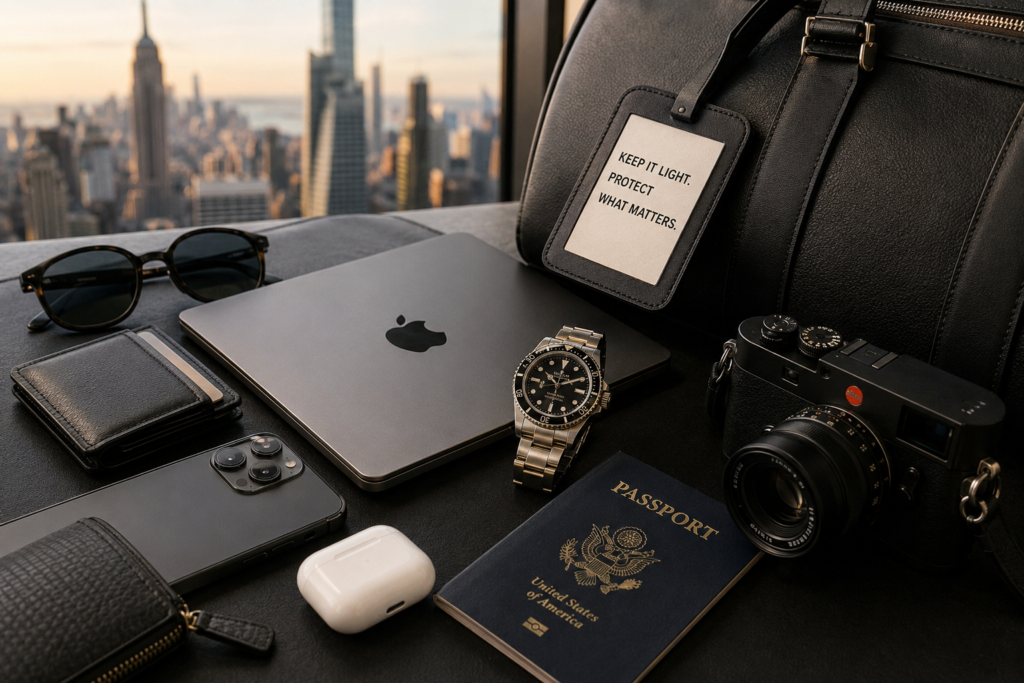
There is a widespread misconception that owning less automatically reduces financial risk.
It does not. In practice, the opposite is often true.
Owning less still means owning something valuable
When you choose to own less, every remaining item tends to carry greater financial, functional, and emotional value.
A frequent traveler moving between New York, Los Angeles, Miami, Chicago, London, Tokyo, and Paris rarely accumulates unnecessary possessions.
Instead, they typically invest in a small collection of premium assets:
- A high-end watch
- A professional camera
- A durable laptop
- Premium luggage
- Refined accessories
- Versatile, long-lasting wardrobe essentials
The problem is simple:
The fewer items you own, the greater the financial impact of losing any one of them.
According to the U.S. Bureau of Labor Statistics, highly mobile, high-income American households spend thousands of dollars annually on durable goods tied to mobility, technology, and functional lifestyle optimization.
At the same time, data from the Federal Bureau of Investigation (FBI) shows that property theft and loss remain persistent concerns in dense urban centers, major airport hubs, and high-traffic international destinations.
Our editorial position is clear: Asset minimalism demands maximum protection discipline.
Anyone who ignores this is romanticizing simplicity while exposing real wealth.
Why owning less requires smarter protection
There is a classic mistake financially informed travelers make: confusing simplicity with financial immunity.
Just because you own fewer things does not mean you carry less risk.
In reality, living with less often means concentrated asset exposure.
🎒 Calculate Your Concentrated Risk
Enter the estimated value of the items currently in your carry-on bag.
That all fits inside a single carry-on bag.
If it disappears, the financial damage is severe.
That is why protect valuable belongings must be treated as an asset strategy—not a logistical afterthought.
See how to build effective insurance coverage for digital nomads.
The costliest mistake sophisticated travelers make
Most people protect financial assets better than physical assets.
They monitor:
- Federal Reserve reports
- ETF performance
- Inflation trends
- Yield curves
- International portfolio allocation
But neglect:
- Physical tracking systems
- Asset documentation
- Digital redundancy
- International insurance coverage
That is inconsistent.
The National Institute of Standards and Technology (NIST) reinforces that modern asset loss is often tied to operational negligence rather than technological limitations.
In other words: Risk rarely comes from lacking tools.
It comes from lacking systems. And protect valuable belongings depends entirely on systems.
Inventory is your first layer of protection
🛡️ Inventory Readiness Audit
Check the items you currently have documented for your premium gear.
You are highly vulnerable to claims denial.
Most people only realize this after something is lost.
A strong asset inventory includes:
- Serial numbers
- Purchase dates
- Digital receipts
- Updated estimated value
- Detailed photos
- Videos
- Warranty documentation
- Maintenance records
The Federal Emergency Management Agency (FEMA) explicitly recommends detailed inventories for insurance validation and financial recovery.
This matters even more for international travelers.
If your laptop disappears in Lisbon or your camera is stolen in Barcelona, proper documentation speeds every claim.
Without it? You depend on bureaucratic goodwill.
And that is never smart financial planning.
The best systems to protect valuable belongings
Our honest review of the most effective tools used by sophisticated American travelers:
The psychological mistake stylish travelers make
Many Americans treat premium possessions as extensions of identity. That creates overconfidence.
They think: “No one would touch this.”
Or: “I would notice immediately.”
You probably would not.
The Transportation Security Administration (TSA) logs thousands of lost-item cases every month in U.S. airports.
Many involve premium belongings forgotten by highly organized travelers. The issue is rarely carelessness.
It is routine familiarity. You relax because you believe you control the process. That is exactly when losses happen.
The Three-Backup Rule
Every sophisticated traveler should follow this:
International insurance: the overlooked asset
Americans routinely underestimate global coverage gaps. That is expensive.
Many assume homeowners insurance covers everything worldwide. It often does not. Or only covers partial loss.
According to the National Association of Insurance Commissioners (NAIC), international exclusions vary significantly between insurers.
Before traveling, review:
🌍 The International Coverage Audit
Does your homeowner’s insurance actually protect you in Europe or Asia? Check what you’ve verified:
Assuming your policy covers everything internationally is an expensive mistake. Premium assets require premium policies.
How smart style reduces risk
Few people understand this: Good style lowers asset exposure. Discrete pieces attract less attention.
Gear without aggressive branding reduces theft targeting.
Neutral technical backpacks outperform flashy luxury luggage.
Our strong opinion: Loud luxury is poor mobility strategy.
Real elegance is invisible.
And that helps protect valuable belongings.
Loud Luxury
Heavy logos. Instantly recognizable designer patterns. Flashy hardware.
Acts as a beacon for professional thieves in urban centers.
Quiet Luxury
Neutral technical fabrics. Unbranded exteriors. High-end construction.
Elegant protection without unnecessary visibility.
The real test before every trip
Ask yourself:
“If I lost this today, could I absorb it without meaningful financial damage?”
If the answer is no:
Upgrade your protection immediately.The financial cost of negligence
Consider common losses:
📉 The Future Cost of Lost Gear
Enter the value of gear you might lose. See what that money would have become if it stayed invested at 8%.
Our honest conclusion
There is a difference between owning less and owning intelligently. Many American travelers master the first.
Very few master the second. Protect valuable belongings is not material obsession.
It is financial respect. It is consistency.
It means treating physical assets with the same seriousness you give your ETFs, retirement accounts, and tax strategy.
In the end, living with less only works when what remains is genuinely protected.
And smart travelers understand this: Freedom is not about carrying less.
It is about carrying only what matters—and protecting it like real wealth.
Related content
How the One-In, One-Out Rule helps you
Learn how the one-in, one-out rule helps travelers control spending, reduce clutter, and build smarter habits.
Keep reading * You will remain on the current website
I have been a content producer for over 10 years, specializing in online writing across a wide range of topics—particularly finance, health, and human behavior. I’m an expert in SEO-driven writing and cultural research.