
How the One-In, One-Out Rule helps you stop overspending
Learn how the one-in, one-out rule helps travelers control spending, reduce clutter, and build smarter habits.
The One-In, One-Out Rule to control spending
The one-in, one-out rule is one of the smartest strategies for North American travelers who want to stop spending beyond what is necessary without sacrificing style, mobility, or financial freedom.
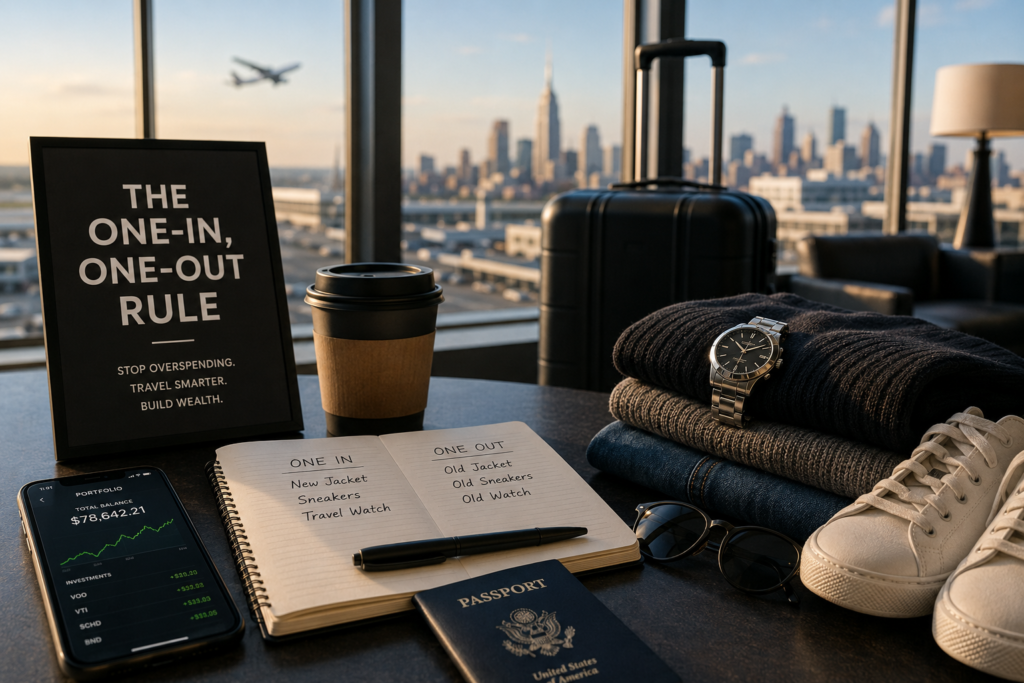
Even if consumers actively follow investment markets and keep up with Federal Reserve reports, they are still not immune to impulse buying while traveling.
How impulse purchases happen while traveling
You could be in New York, Chicago, Miami, Los Angeles, Seattle, or on any international stopover as a frequent traveler.
You land in Paris and buy a trench coat because it feels like “an investment in your image.”
You arrive in Tokyo and buy gadgets because “Japanese technology is simply better.”
You pass through Austin and buy boots because “they match the city.”
It feels rational. But it rarely is.
According to the Bureau of Economic Analysis (BEA), personal consumption accounts for roughly 68% of the U.S. economy, largely driven by discretionary purchases tied to lifestyle, convenience, and aspirational repositioning.
At the same time, the Federal Reserve Bank of New York reports that revolving credit card debt in the United States remains above $1 trillion, even among highly educated, high-income consumers.
Our view is straightforward:
Modern excess is not created by a lack of money. It is created by a lack of clear consumption criteria.
And that is exactly what the one-in, one-out rule corrects.
Here is how it works.
What does the One-In, One-Out Rule actually mean?
The Golden Rule of Asset Governance
Bought new boots in Austin
Sell or donate an old pair
Does this deserve physical, financial, and mental space in your life?
Bought a new jacket? Donate or sell an older one.
Bought sneakers in Los Angeles? Another pair leaves.
Brought back an extra suitcase from Europe?
Remove equivalent items.
The one-in, one-out rule is not about aesthetic organization.
It is about personal asset governance. It forces one powerful question:
Does this deserve physical, financial, and mental space in my life?
If the answer is not an absolute yes, do not buy it.
The invisible problem of the sophisticated traveler
🎭 The Cultural Identity Trap
“This piece represents my experience in Milan.”
The RealityIt is an emotional souvenir disguised as sophistication.
“This gadget from Seoul carries emotional value.”
The RealityIt is romanticized excess with zero proportional utility.
The U.S. Bureau of Labor Statistics shows that upper-middle-income American households spend thousands annually on discretionary purchases related to fashion, technology, and travel-based lifestyle acquisition.
Much of that spending delivers little proportional utility.
The purchase becomes an emotional souvenir disguised as sophistication.
This is where the one-in, one-out rule protects you from yourself.
The real financial cost of unfiltered consumption
💸 The Real Cost of Unfiltered Spending
Average annual travel spend: $10,500. Adjust the slider to see what your impulse purchases cost you over 20 years.
$4,200
$192,198
Why smart consumers still fail
Most people believe information alone is enough. It is not.
The National Bureau of Economic Research (NBER) has repeatedly shown that financial behavior is driven far more by decision architecture than isolated technical knowledge.
You can fully understand valuation models, ETFs, and compound interest— and still buy a third black jacket in Manhattan.
Because knowledge does not stop impulse. Structure does.
And the one-in, one-out rule creates automatic structure.
The best practical applications for travelers
1. Premium Clothing
Before buying, ask: Which current piece leaves?
If there is no clear answer, do not buy it.
You do not need it.
2. Technology
Americans love unnecessary upgrades.
A new iPad. A new headset. A new camera.
The rule forces rationality: Which current device is this replacing?
If you cannot answer clearly, do not buy it.
3. Luggage
The American market constantly pushes upgrades.
Away, Samsonite, Tumi, and Briggs & Riley have all built powerful aspirational branding.
Our honest assessment:
The psychological effect that changes everything
Researchers at Harvard Business School have shown that decisions with explicit cost reduce impulsivity. When buying something requires “losing” something you already own, your brain reassesses real utility.
That is what the one-in, one-out rule does. It creates visible cost.
Without visible cost, consumption becomes reflex. With visible cost, it becomes choice.
And rational choice builds wealth.
The classic mistake stylish Americans make
Many confuse curation with accumulation. Expensive closets often reveal poor intentionality.
Accumulation
Owning 35 jackets. Buying impulsively. Justifying excess as “options”.
Weak filtering and consumption anxiety.
Curation
Owning 5 perfect jackets. Strict 1-in, 1-out. Buying with intention.
Refined taste and financial sophistication.
How to apply it during international travel
Every purchase must pass three filters:
🛡️ The 3-Step Purchase Filter
Holding an item in a store? Pass this test first.
You must pass all three filters to proceed.
The financial results after 12 months
Travelers who consistently apply the rule report:
- Fewer impulse purchases
- Greater asset clarity
- Better space efficiency
- Less waste
- Higher available liquidity
That extra liquidity often gets redirected into:
- ETFs
- Better travel experiences
- Truly meaningful upgrades
- Strategic cash reserves
That is intelligent wealth.
Our honest conclusion
There is a reason sophisticated consumers often end up financially average:
They treat excess as identity. It is not. It is noise.
The one-in, one-out rule removes that noise and restores intention to consumption.
And intentional consumption is the real marker of financial sophistication.
In the end, style is not about owning more.
It is about owning better.
And smart travelers understand that financial freedom weighs less in a suitcase—and is worth infinitely more over the long term.

Related content
How to plan a budget park trip
Plan a budget-friendly national park trip with smart money-saving strategies, minimalist packing, and stylish travel tips.
Keep reading * You will remain on the current website
I have been a content producer for over 10 years, specializing in online writing across a wide range of topics—particularly finance, health, and human behavior. I’m an expert in SEO-driven writing and cultural research.