
Minimalist Vacation Guide: Avoid Hidden Fees and Travel Smarter
Avoid hidden travel fees in the U.S. Learn how minimalist travelers save money with smarter planning and zero surprise costs.
Stop Overpaying: The Hidden Travel Fees Minimalists Avoid

Most travelers believe a minimalist trip automatically saves money.
In the United States, that assumption can quietly cost you hundreds.
Less luggage. Less consumption. Fewer extras.
Sounds efficient — but here’s the problem: hidden travel fees.
They don’t appear in the initial price.
They’re not highlighted on booking platforms.
And by the time you see them, your budget is already compromised.
If your goal is to travel smarter, spend less, and make financially sound decisions, this guide will show you exactly how to eliminate invisible costs and structure a truly efficient trip.
What Are Hidden Travel Fees in the U.S.?
Hidden travel fees are charges that are not clearly displayed upfront but are added during checkout—or worse, after you’ve already committed.
In the U.S., pricing is fragmented by design.
That means:
- The price you see is rarely the price you pay
- Fees are distributed across multiple stages
- Transparency is often minimal
Common hidden costs include:
- Taxes and service fees
- Resort and facility fees
- Airline add-ons
- Rental surcharges
- Currency conversion spreads
The Minimalist Traveler’s Biggest Financial Mistake
The biggest mistake?
Believing that spending less automatically leads to saving more.
It doesn’t.
In reality, most travelers lose money not through excess—but through poor cost visibility.
Here’s what that looks like:
| Item | Advertised Price | Final Price |
|---|---|---|
| Hotel (per night) | $120 | $165 |
| Domestic flight | $89 | $140 |
| Car rental (per day) | $45 | $78 |
The difference isn’t luxury.
It’s hidden structure.
Minimalism without financial awareness is just aesthetic minimalism.
Where Hidden Fees Are Hiding (And How to Avoid Them)
Hotel Fees You Didn’t Expect
In cities like New York and Las Vegas, hotels frequently add:
- Resort fees (up to $50/day)
- Cleaning fees
- Mandatory local taxes
- Paid amenities
How to avoid them:
- Always check the final booking screen
- Multiply total nights + all fees
- Compare official vs third-party platforms
Rule: Never compare nightly rates. Compare total stay cost.
Airline Fees That Destroy Cheap Flights
Low-cost airlines often show attractive base fares—but include almost nothing.
Typical add-ons:
- Carry-on baggage: $30–$60
- Checked baggage: $40–$100
- Seat selection: $15–$50
- Boarding priority: $20+
| Flight Type | Base Price | Final Price |
|---|---|---|
| Low-cost | $79 | $180 |
| Traditional airline | $140 | $160 |
Minimalists win here—but only if they plan deliberately.
Car Rental Traps in Major U.S. Cities
In places like Los Angeles and Orlando, rental pricing is designed to upsell.
Common traps:
- Insurance pressure
- Airport surcharges
- Additional driver fees
- Fuel markups
Smart approach:
- Check credit card coverage
- Document the car condition
- Decline unnecessary upgrades
Currency Exchange and Payment Fees
This is where most international travelers quietly lose money.
| Payment Method | Extra Cost |
|---|---|
| Standard credit card | Up to 6.5% |
| Global account | 1%–2% |
Avoid:
- Paying in your home currency
- Dynamic currency conversion
In the U.S. market, foreign transaction fees typically range from 1% to 3%, while debit cards can reach 4%+ when combined with network charges.
On top of that, choosing to pay in your home currency (dynamic conversion) can add up to 6% extra.
In the worst-case scenario, travelers end up paying 8% to 10% more on the same purchase.
Rule: always pay in the local currency and use a no-foreign-transaction-fee card. See Forbes’ tip for saving on hidden travel fees.
How Much Hidden Fees Can Actually Cost You
This is where it becomes real.
| Trip Type | Hidden Fees (Avg) |
|---|---|
| Budget trip | $150–$300 |
| Mid-range trip | $300–$700 |
| Premium trip | $700+ |
That’s not a small leak.
That’s a structural cost problem.
How Minimalist Travelers Actually Save Money
Here’s the shift:
Smart minimalism isn’t about reducing spending. It’s about eliminating inefficiency.
That means:
- Paying intentionally
- Avoiding invisible costs
- Prioritizing flexibility
A Simple Framework for Smarter Travel Spending
1. The 3-Filter Rule
Before any purchase:
- Is there a hidden fee?
- Is there a more transparent option?
- Am I paying for convenience or necessity?
2. Reverse Budgeting Strategy
Instead of starting with the destination:
- Total budget: $1,500
- Reserve 20% for hidden costs
- Plan with the remaining 80%
3. Centralizing Your Expenses
Use one strategic payment method.
Benefits:
- Better tracking
- Fewer hidden fees
- Cleaner financial control
The Hidden Trick Smart Travelers Use (Almost No One Talks About)
Here’s the move that changes everything:
Plan your trip as if you might cancel everything tomorrow.
Why this works:
- Hidden fees appear in cancellation policies
- Non-refundable bookings reveal real risk
- Flexibility becomes measurable
Example:
- Hotel A: cheaper, non-refundable
- Hotel B: more expensive, free cancellation
Most people choose A.
Smart travelers choose optionality.
Final Checklist Before Booking Anything
Before confirming:
- Did I see the full final price?
- Do I understand all fees included?
- Did I compare at least two options?
- Can I cancel without losing money?
- Are there payment-related hidden costs?
If any answer is “no,” you’re not ready to book.
If you want to cut even more costs, check out the essential minimalist travel gear that helps you save money on every trip.
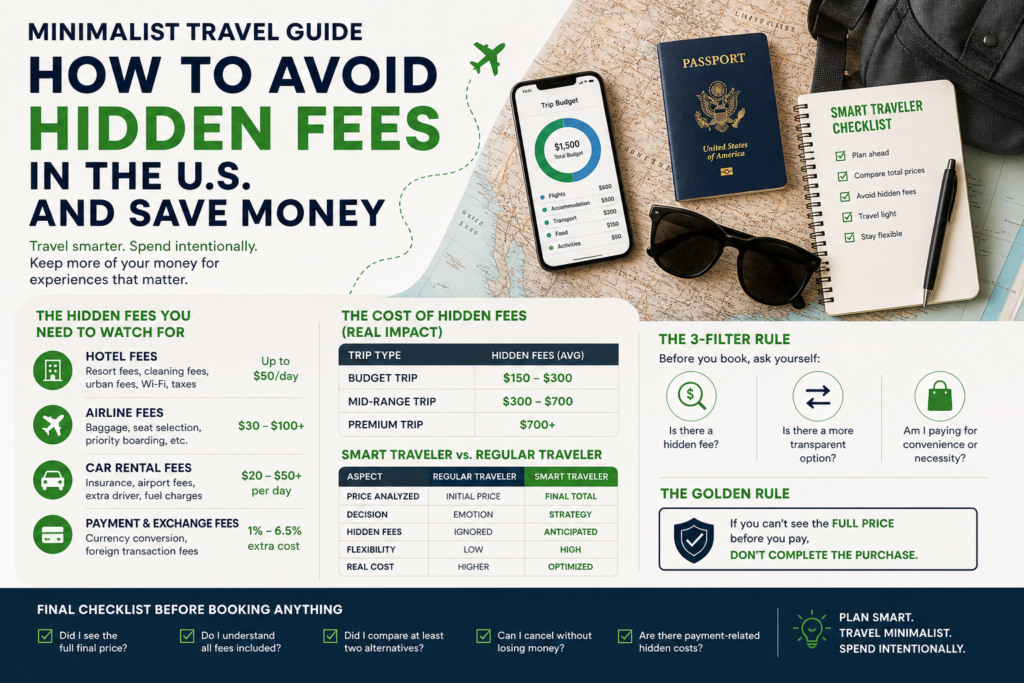
Image to save on your phone
Save this image to your phone and review it whenever you plan your next trip.
Conclusion: Travel Smarter, Not Just Cheaper
Minimalism isn’t about doing less.
It’s about removing what doesn’t create value.
In the U.S., that means one thing:
understanding how money actually flows during a trip.
Travelers who master this:
- Spend less
- Avoid frustration
- Make better decisions
- Travel with control
In the end, it’s not about finding the cheapest option.
It’s about paying exactly what something is worth—nothing more.
FAQ: Hidden Travel Fees and Minimalist Travel

Related content
Reset Your Finances Without Starting Over
Discover practical ways to reset your finances using flexible strategies that fit real life without rebuilding your entire budget.
Keep reading * You will remain on the current website
I have been a content producer for over 10 years, specializing in online writing across a wide range of topics—particularly finance, health, and human behavior. I’m an expert in SEO-driven writing and cultural research.