
Cheap U.S. Weekend Getaways
Discover cheap U.S. weekend getaways with smart planning tips, budget travel strategies, and minimalist escapes.
Low-Cost U.S. Weekend Travel

Traveling cheaply in the United States feels impossible for many people.
What most travelers face is simple: inflated hotel rates, absurd airfare, and hidden fees everywhere.
It often feels like any weekend getaway will cost the equivalent of a small financial crisis.
But here is this site’s clear position:
Affordable travel in the U.S. does not depend on luck. It depends on strategy.
That is because real luxury is not about spending more.
It is about traveling better.
According to data from the U.S. Travel Association, domestic tourism remains dominant, accounting for roughly 87% of total American travel spending.
That means one thing: Americans are traveling heavily within their own country.
And when demand rises, travelers without strategy pay the highest price.
✈️ Cheap travel is planned travel.
The smartest travelers pay with strategy, not urgency.
The myth of the cheap destination
Most people think like this: “Which city costs less?”.
Wrong question.
The right question is:
“When does this destination cost less?”
In the U.S., timing matters more than location.
Here is what that looks like:
| Destination | Peak Season | Ideal Off-Season |
|---|---|---|
| Miami | Dec–Apr | September |
| Las Vegas | Mar–May | July |
| Nashville | Spring | January |
| Sedona | Mar–Apr | August |
| Bar Harbor | Jun–Oct | May |
The exact same trip can cost 30% to 60% less depending on the week.
Real case: Austin → Santa Fe
David, 33, lives in Austin. He used to travel impulsively.
Typical result:
- premium hotel
- late flight booking
- tourist restaurants
Weekend cost: $1,350.
Then he changed strategy:
- booked 8 weeks ahead
- traveled off-season
- stayed in smaller boutique hotels
- set a strict daily spending cap
New cost: $520.
Same perceived quality. More control. Far less waste.
That is the difference between emotional tourism and intelligent travel.
🔥 Smart traveler rule:
Travel off-season, book early, spend intentionally.
The best affordable U.S. weekend destinations
Savannah
Perfect for:
- historic walks
- architecture
- minimalist cafés
Real cost range: $350–$650.
Pros:
- incredible charm
- highly walkable
Con:
- brutal summer heat
Santa Fe
Excellent in off-season.
Range: $400–$700.
Pros:
- stunning design
- unique atmosphere
Cons:
- premium restaurants get expensive fast
Portland
Ideal for visual minimalists.
Range: $500–$800.
Pros:
- clean aesthetic
- great food
Cons:
- prices spike quickly in summer
Asheville
Strong overall balance.
Range: $400–$650.
Pros:
- mountain access
- craft brewery culture
Con:
- crowded during holidays
The mistake that makes travel expensive
Trying to “make the most of it.”
That usually creates:
- overloaded schedules
- unnecessary transportation
- expensive convenience meals
- impulse shopping
Intentional travel creates the opposite:
- Less activity. More presence.
- Lower cost. Better experience.
🧭 Fewer plans
Better focus
💵 Lower costs
Less waste
✨ Better memories
Higher quality
Useful tools
Google Flights
Best for flexibility.
Amtrak
Underrated, especially in the Northeast Corridor.
National Park Service
Recent visitation shows Americans continue choosing nature as a high-value, low-cost option.
Airbnb
Good for groups.
But compare with boutique hotels. Sometimes Airbnb is more expensive.
The real math
Impulsive weekend:
| Category | Cost |
|---|---|
| Late airfare | $380 |
| Premium hotel | $450 |
| Food | $250 |
| Extras | $180 |
| Total | $1,260 |
Planned weekend:
| Category | Cost |
|---|---|
| Early transportation | $120 |
| Smart hotel | $210 |
| Local dining | $90 |
| Extras | $70 |
| Total | $490 |
Difference: $770!
Enough to fund another entire trip.
The psychological trick
Behavioral finance research shows urgency increases false value perception.
That is why this works:
Wait 48 hours before booking.
If it still makes sense, book it.
That pause saves money.
💡 Minimalist move
If a trip only feels exciting when rushed, it is probably overpriced.
How to travel elegantly for less
Minimalism is not discomfort.
It is aesthetic intention.
Do this:
- one premium backpack
- neutral clothing
- carefully curated small hotels
- local coffee shops
- free experiences
That creates real sophistication.
Not tourist performance.
When Should You Start Planning a Cheap U.S. Weekend Getaway?
The smartest answer is: Earlier than feels necessary.
Most travelers start planning when excitement hits.
That is exactly when prices are already rising.
Minimalist travelers do the opposite:
They plan when there is no urgency.
That usually means:
| Trip Type | Ideal Planning Window |
|---|---|
| Nearby road trip | 3–5 weeks before |
| Domestic flight weekend | 6–10 weeks before |
| Popular seasonal destination | 10–16 weeks before |
| Holiday weekends | 4–6 months before |
Why?
Because this is when you get:
- better airfare inventory
- stronger boutique hotel rates
- more flexible cancellation policies
- time to monitor price drops
- space to adjust your budget calmly
The biggest financial mistake is treating travel like an impulse purchase.
The smartest travelers treat it like an investment decision.
🗓️ Smart timing wins
Plan while prices are calm — not when demand is loud.
A strong practical rule:
The cheaper you want the trip to feel, the earlier you should start planning it.
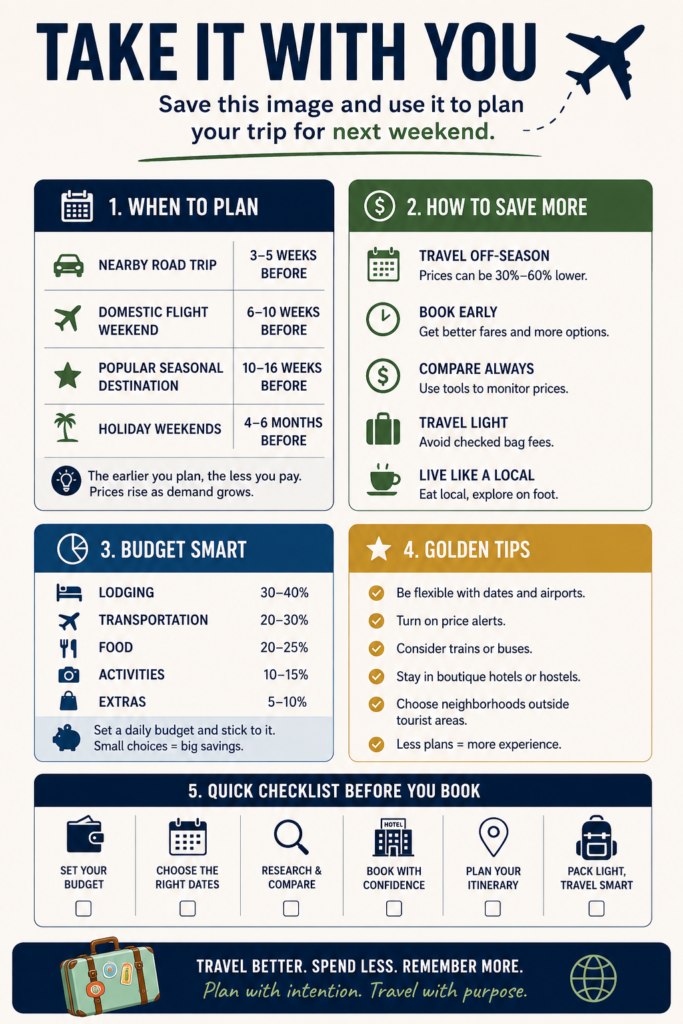
Final checklist
Before booking:
✓ Am I traveling off-peak?
✓ Did I book early?
✓ Is my budget fixed?
✓ Is this a real desire?
✓ Am I paying for experience — or ego?
If the answer is ego:
Reassess.
💭 The right question is not:
“How cheap can this trip be?”
👉 It is:
“How intentional can this trip become?”
Conclusion
America’s smartest travelers do not travel less.
They travel better. They know how to wait. They know how to plan.
They know when to say no to excess.
And they understand something simple:
The best cheap trip does not feel cheap.
It feels intelligent.

I have been a content producer for over 10 years, specializing in online writing across a wide range of topics—particularly finance, health, and human behavior. I’m an expert in SEO-driven writing and cultural research.